
Breaking Free to Move Forward: Reflection for Leaders (Day 13 of the 90 Days Black Leadership Marathon)
- Reflection as Leadership Growth
- Why pausing matters on the leadership journey
- Healing and forgiveness as foundations for lasting impact
- Reflecting on Healing – Breaking the Unwholeness (Day 1)
- Revisiting the message of healing
- Reflective questions: What wounds still linger? How free are you from the past?
- Reminder: Healing is ongoing, not a one-time act
- Reflecting on Forgiveness – Breaking Free from Yesterday (Day 2)
- Forgiveness as release and strategy
- Reflective questions: What have you done that still lives rent-free in your mind? Have you forgiven yourself?
- Acknowledging forgiveness as strength
- Connecting Healing and Forgiveness in Leadership
- How healing and forgiveness work together
- Why leaders need both to carry vision without weight
- Call to revisit and re-engage with the Day 1 and Day 2 lessons
- Conclusion: Carrying Forward with Healing and Forgiveness
Reflection as Leadership Growth
Leadership is not only about charging forward; it is also about pausing long enough to look back and ask, “What have I learned, and how has it shaped me?” Reflection is a discipline that allows growth to take root. Without it, progress can become noise rather than transformation.
As we journey through this 90-day leadership marathon, Day 13 invites us to pause and revisit the ground we covered at the beginning. Day 1 reminded us that healing is the first repair work of leadership; that unhealed wounds can quietly dictate our decisions, our relationships, and even the way we see ourselves. Day 2 challenged us to forgive, especially ourselves, so that yesterday’s mistakes do not shackle tomorrow’s potential. These two themes, healing and forgiveness, are not quick lessons to check off, but enduring practices that deserve regular reflection.
Today’s piece is not about adding more lessons. Instead, it is about asking the right questions and allowing space for honest answers. Reflection sharpens awareness, clears hidden weight, and re-centers purpose. Before moving further into the marathon, let us pause, breathe, and measure: How much lighter are we today than when we began?

Section 1: Reflecting on Healing – Breaking the Unwholeness (Day 1)
Healing is not a destination; it is a journey that runs parallel with leadership. The premise of Day 1 was simple yet profound: before you can lead others with clarity, you must first lead yourself toward wholeness. Wounds that go unattended, whether they come from family history, past failures, rejection, or silent disappointments, don’t simply fade away with time. They linger beneath the surface, shaping how we see ourselves and how we respond to others. A leader who has not taken the time to heal may end up leading from pain rather than from purpose.
Now, as we reflect, the question becomes:
How far have you come since that first reminder? Healing does not happen in a single step. It is the small, intentional practices like acknowledging pain, releasing shame, seeking help, and embracing rest that gradually rebuild strength.
Consider these reflective questions as you pause today:
- How free are you from the past? Do certain memories still dictate your choices or reactions?
- What hidden wounds are you still carrying? Are there unspoken experiences that weigh you down quietly?
- Have you created intentional space for self-care and mental repair? Or do you find yourself pushing forward without tending to what hurts inside?
- Who do you allow into your healing space? Do you have trusted people, mentors, or peers who can walk alongside you?
Healing cannot be rushed, and it cannot be faked. The truth is, it is a cycle: some days you feel strong and whole, other days the old scars remind you they still exist. That is not failure; it is simply the rhythm of recovery. What matters is that you do not ignore it.
A practical way forward is to journal your thoughts after answering the questions above. Writing them down gives form to what often feels like vague emotions. It allows you to notice patterns and see progress that otherwise might go unseen. For others, the practice may be quiet reflection or meditation, giving the mind room to release tension without distraction.
Healing is not a one-time milestone to check off; it is an ongoing discipline, and as you grow lighter within, your leadership gains clarity, focus, and compassion that others can feel.

Section 2: Reflecting on Forgiveness – Breaking Free from Yesterday (Day 2)
Forgiveness, as we explored on Day 2, is not just an emotional gesture; it is both a release and a strategy. To forgive is to free yourself from the weight of yesterday so that today’s energy can be fully invested in building tomorrow. Without forgiveness, leadership becomes clouded by grudges, distracted by old pains, and slowed by the mental load of carrying resentment.
Forgiveness is often misunderstood. Many see it as excusing the offense or letting someone “off the hook.” In truth, forgiveness is not about them; it’s about you. It’s about reclaiming the focus and clarity that bitterness quietly steals. A mind filled with grudges is a mind with less space for vision. A heart stuck on anger has less room for courage and creativity.
Pause for a moment and reflect:
- What have you done that still lives rent-free in your head?
- What grudges keep draining your focus? Think about how much mental energy is tied to replaying certain stories instead of writing new ones.
- Have you forgiven yourself for past mistakes so you can move forward? Sometimes the hardest person to forgive is not others; it is the reflection in the mirror.
The cost of unforgiveness is subtle but real. Leaders who cannot let go of the past often struggle to make bold decisions in the present. They second-guess themselves, avoid risks, or project their unhealed hurt onto their teams. Forgiveness, then, is not weakness; it is strength. It requires courage to set down the weight you have carried, courage to choose freedom over chains.
When you forgive yourself, you are not only releasing pain, you are sharpening your vision. Forgiveness fuels clarity. It allows you to stand before others without distraction, to act without hesitation, and to see the future without the fog of old stories. A leader anchored in forgiveness is one who can face tomorrow with steady hands.
Forgiveness is not a one-time act but a practice. Some memories return, and you may need to forgive again. That does not mean you failed; it means you are still choosing freedom, and each time you choose it, your leadership becomes lighter, clearer, and more powerful.
Section 3: Connecting Healing and Forgiveness in Leadership
Healing and forgiveness are not separate rivers; they flow into each other. One without the other leaves a gap. You cannot forgive deeply if you are still raw from unhealed wounds, and you cannot heal fully if you refuse to let go of the anger, guilt, or disappointment that keeps you tied to yesterday. Together, they form the foundation of inner strength that leadership demands.
Think about it: healing closes the wounds so you no longer bleed into every decision or interaction. Forgiveness removes the chains so you can walk forward without dragging the past behind you. When both are in motion, you are not only lighter, you are clearer, and clarity is priceless for a leader tasked with carrying vision, guiding people, and making choices that affect more than just themselves.
- Healing without forgiveness is like patching a wound but leaving the poison inside. The surface may look better, but the root issue keeps spreading.
- Forgiveness without healing is like painting over cracks in the wall without repairing the foundation. Eventually, the break will show again.
- Healing plus forgiveness builds wholeness. Wholeness allows leaders to lead without unnecessary weight, without second-guessing, and without carrying invisible baggage into every room they enter.
Leadership is not just about strategies, plans, or charisma; it is about inner freedom. A bound leader cannot free others. A heavy-hearted leader cannot lift a community. But a leader who heals and forgives hinself first, walks with a calm strength that others instinctively trust.
Here’s your call to action:
Take time today to revisit theDay 1 article on healing and the Day 2 article on forgiveness. Re-read them with fresh eyes, and don’t just skim; sit with the reflective questions. Write your answers honestly. Notice what has shifted in you since then, and where you may still need to go deeper.
Growth doesn’t happen in a straight line; it happens in cycles of reflection, release, and renewal. Healing and forgiveness are not boxes to tick off; they are practices to return to, and every return makes you stronger.
Conclusion: Carrying Forward with Healing and Forgiveness
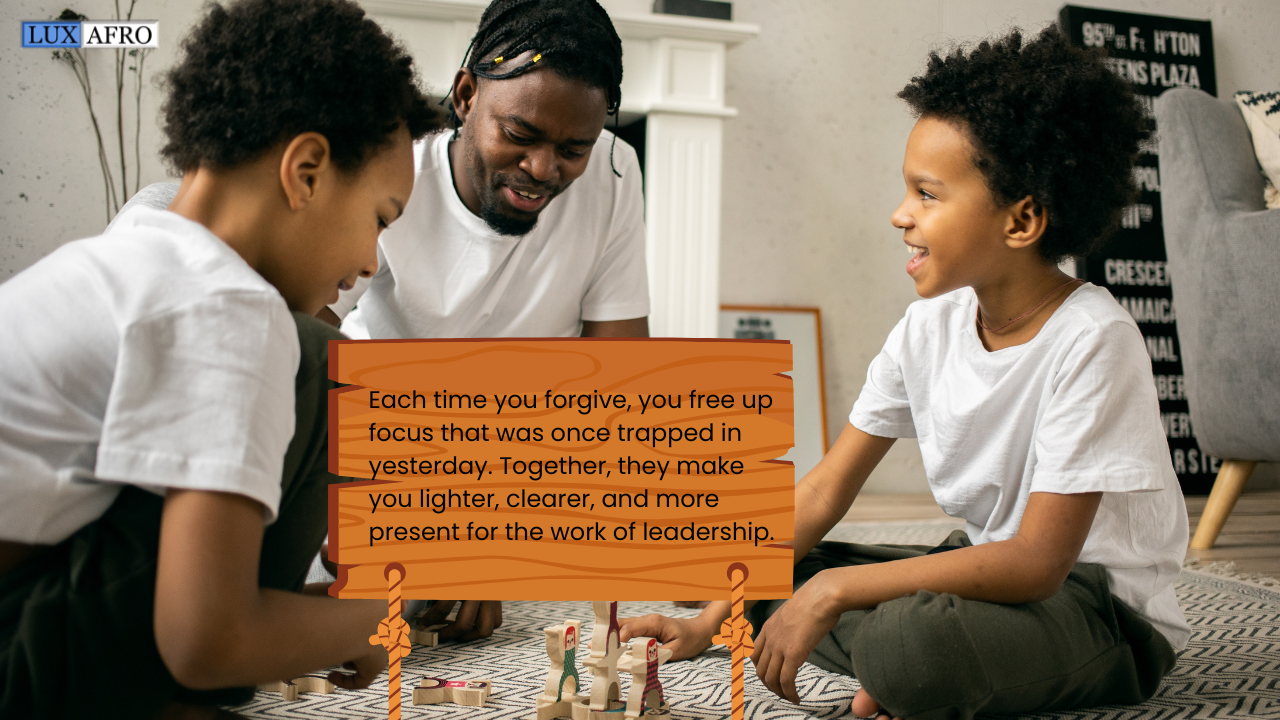
Healing and forgiveness are not items on a checklist to mark “done” and forget. They are living practices; ones that must be returned to, refreshed, and deepened as life unfolds. Each time you pause to heal, you reclaim energy that was once drained by old wounds. Each time you forgive, you free up focus that was once trapped in yesterday. Together, they make you lighter, clearer, and more present for the work of leadership.
Every strong leader knows that moving forward is not only about ambition or vision, it is also about the discipline of reflection. To pause is not weakness; it is wisdom. To look back is not a delay; it is preparation. The leader who carries healing and forgiveness walks into tomorrow’s challenges with a steadiness that others can feel.
So here is the question to carry with you:
As you step into tomorrow’s challenges, are you carrying healing and forgiveness with you, or are you dragging yesterday along?
Remember, you don’t have to navigate this journey alone. Coach Dudu is here to help guide you through these practices, with tools and insights designed to strengthen your leadership path. By joining the LuxAfro membership, you’ll gain access to worksheets and resources that serve as practical companions for each topic we cover in this 90-day journey. These tools are not just information; they are guides to help you practice healing, forgiveness, and every other pillar of leadership in real time.
Lighter leaders last longer. Step forward with that in mind.